Latest on Lethal Autonomous Weapons Policy, Upcoming Events and IEEE Humanoids discount code expires Thanksgiving
“Sometime yesterday the robot fell over.”
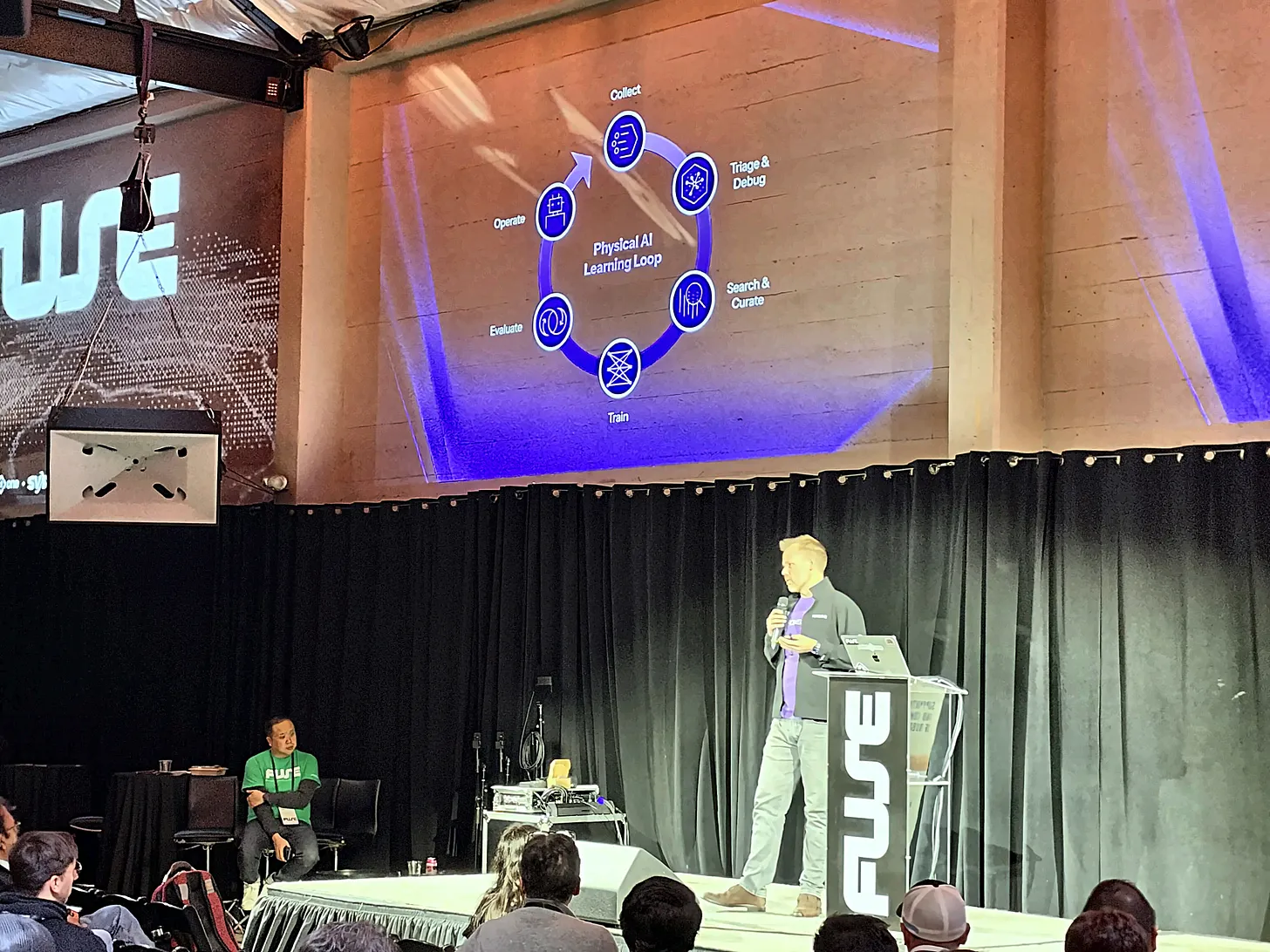
That’s the incident ticket most robotics teams actually get. At FUSE San Francisco, Adrian Macneil, co-founder and CEO of Foxglove, walked through how to turn tickets like that into a learning loop:
📼 Log in a format that outlives your code. MCAP files describe themselves, so you can open one years later without hunting down the right version of the codebase.
🚚 Split your data into two paths. Stream lightweight telemetry to the cloud constantly, and keep full raw logs in a rolling buffer on the robot.
🤖 Let agents do the first pass. Models have gotten good at digging through logs and narrowing down why a robot failed.
🐴 Search for the long tail. One team expanding into Texas found its robots had plenty of data on police cars and horses, but none on police on horseback.
🗂️ Logging and training want different layouts. Re-sort logs by topic before they go to the GPU.
📍 The dream ticket names the cause: RTK dropped from fixed to float under an awning, the estimate shifted 20 to 30 cm, and the planner trusted it.
“We can SSH in and fix it” is fine for one or two robots. Not for 100.”
At FUSE San Francisco, Amit Moran, CTO of Civ Robotics, shared what it takes to scale construction robotics:
🌍 The real world is your lab. Get into the field early, learn fast, iterate.
🧮 Minimize the variables. Solve one problem you can repeat, then expand.
🛜 Understand the task before picking the tech. RTK, IMU, sensors: choose for the job, then find what ties them together.
🦾 Design for deployment and support from day one. Plan for 1, then 100, then 1,000.
On remote job sites with little or no connectivity, plug-and-play is what makes scale possible: drop the unit, get an RTK fix, start working.
“A well-run autonomous tractor should be boring to watch.”
At FUSE San Francisco, Jim Ostrowski, CTO of Blue River Technology, shares lessons from bringing autonomy to ag, construction, turf and forestry:
🎯 Pick the right ODD early. Start with tillage, not harvesting. Daytime, no dust. Expand as the tech matures.
🛡️ Perception is key to safety, but so is localization. Geofenced boundaries let you deploy faster and more safely.
🌳 Transient GPS outages are the real challenge. Orchard canopies, quarries and buildings mean constant handoffs between good and bad signal, and resyncing afterward.
🚜 Machines that work together need shared localization. A meter is fine on the haul road. Next to the excavator, it isn’t.
🔁 Do it once, learn, then generalize. Don’t over-engineer a platform before the first system works.
🤔 His open question for the room: as end-to-end models take over planning and control, how does localization get folded in?
A ground robot can stop when it’s lost. A drone can’t. Lose your position estimate, and you crash.
Today at FUSE San Francisco, Abraham Bachrach, co-founder and CTO of Skydio, sat down with Adam Grosser, chairman and managing partner of UP.Partners, on what it takes to keep autonomy in the air:
👁️ Design for GPS to fail. For its first two years, Skydio flew with no GPS receiver at all, purely on vision. The mindset stuck: use GPS when it’s available, don’t depend on it.
🧱 Layer relative and absolute positioning. Even without knowing exactly where you are, knowing your speed and your relationship to the terrain keeps you flying.
📡 Spoofing is harder to defend against than jamming. Jamming takes the signal away. Spoofing hands you a wrong one.
🛸 Drones are becoming infrastructure. Docked fleets deployed across cities raise new problems: coordination, deconfliction, and relative positioning between aircraft.
🔬 The wish list: sensor diversity. Radar, thermal and lidar that are smaller, lighter, cheaper and lower power.
In 2016, Uber delivered 50,000 cans of beer with no one in the driver’s seat. Ten years later, there are zero commercial autonomous semis on the road.
At FUSE San Francisco, Eyal Cohen, founder and CEO of Humble Robotics, explained why, and what he’s doing differently:
📏 One foot of margin. A semi in a highway lane has about a foot to spare, at 80,000 pounds. In 2016, that had to hold with faded lane lines, patchy RTK, and hardware never built for production.
🔧 Retrofits don’t scale. Bolting autonomy onto a diesel truck built for a driver adds cost and fights the vehicle’s design. An autonomous truck is a data center on wheels, so it should be electric.
⚡ Start short-haul. Much of US freight moves short, repeatable routes between ports, warehouses, plants and rail yards. Humble built its first Humble Hauler prototype in six months.
🏗️ Container yards are the worst place for signals. Stacks of steel containers bounce GNSS everywhere, and that’s exactly where a drayage truck has to know where it is.
🌉 The Bay Area is a localization stress test: the I-280 tunnel, the Bay Bridge lower deck, and the Golden Gate’s narrow lanes.
🛣️ Highways are boring, and that’s the problem. One patch of grass looks like the next, so there’s little to localize against.
📍 His ask for the room: positioning that’s reliable on automotive-grade hardware, cheap, scalable, and works everywhere. “I just want a magic black box” that tells you where you are.
“Robots run on trust. And trust starts with knowing where the robot is.”
At FUSE San Francisco, Jack Morrison, co-founder and CEO of Agency Tool Company Co. and former co-founder and CEO of Scythe Robotics, shared five building blocks of trustworthy positioning, drawn from years of fielding autonomous commercial mowers:
💰 Sourcing: good first, cheap later. Scythe swapped its survey-grade GNSS antenna for a cheaper one, then started losing RTK fix across the fleet. The survey-grade antenna tracked about twice as many satellites, so it went back on.
🔨 Robustness: test harder than your worst user. A bump track shook loose a camera sensor by a few pixels and threw off calibration. Find the failures before your customer does.
📡 Interference: know your baseline. A Jetson’s EMI was drowning out the GNSS signal, and the fix was a lot of copper tape. Solar storms and drifting tectonic plates showed up too.
⏱️ Timing: question every timestamp. Six clocks on one machine, all brought onto a single timeline and checked against RTK ground truth.
⛷️ Redundancy: one tier at a time. Scythe graded its operating zones like ski slopes, from bunny hill to black diamond, adding sensors only as each tier demanded it. 🟦 🟢
🧮 Start with the right inputs, and all the fancy math gets a lot easier.
Highlights from SVR Physical AI Showcase
Devol Robots was the winner of the SVR Startup Pitch Showcase, held on Nov 12 at the 3rd annual Physical AI Conference at Plug’n’Play. The showcase featured Devol Robotics, Inception Robotics, Broz, Ocatvian Robotics and Khameleon. All five of the presenting companies gave very strong short pitches with honorable mention to Octavian Robotics and Khameleon.
Devol Robots
Think about a kid playing with Lego. They don’t learn how the pieces fit by watching videos. They feel them, push, adjust and try again. At Devol Robots, we teach robots the same way: learning physics priors from physical interaction, not just from watching. That’s what lets them do the precise, hands-on factory jobs that automation still can’t. Our Interaction World Model (IWM) learns how contact unfolds, and Devol-ONE uses it to act. Devol-ONE ranks No. 1 on the manipulation benchmarks we report, and it’s already deployed in real manufacturing. We’re a team of about 20. My cofounder Elijah has 10+ years in robot learning, and I ran factories for 10 years serving Samsung and Panasonic. We’re now raising our seed round, and we’d love to hear from investors, and from manufacturers who want to pilot robots that can finally do this work.
Calls to action:
– Investors: We’re raising our seed round.
– Pilot partners: We’re looking for manufacturers in automotive, wire harness (cable routing, connector plugging and more), electronics assembly, and kitting. We’d love to run a pilot with you. Video:
https://www.youtube-nocookie.com/embed/gtppfwLl8kk?rel=0&autoplay=0&showinfo=0&enablejsapi=0
– System integrators: Let’s bring IWM and Devol-ONE into your customers’ lines together.
– Contact: sze@devolrobots.ai |
Inception Robotics

BROZ and FAVIEW
FAVIEW is our spatial AI solution that transforms images and videos into 3D digital twins and combines them with AI-powered spatial understanding and guidance. We are expanding its applications across enterprise digital transformation, robotics, and autonomous navigation.
Our current priorities are:
- Pre-Series A fundraising: We are seeking investment at a target company valuation of approximately US$7.5 million (KRW 10 billion) and would welcome introductions to investors interested in spatial AI, robotics, and enterprise technology.
- Global B2B customers and pilot deployments: We are looking for companies worldwide interested in adopting FAVIEW, particularly in robotics, autonomous driving and navigation, and digital transformation.
If you enjoy Robots & Startups please restack. To receive new posts and support my work, consider becoming a free or paid subscriber.
IEEE Humanoids 2026 discount code
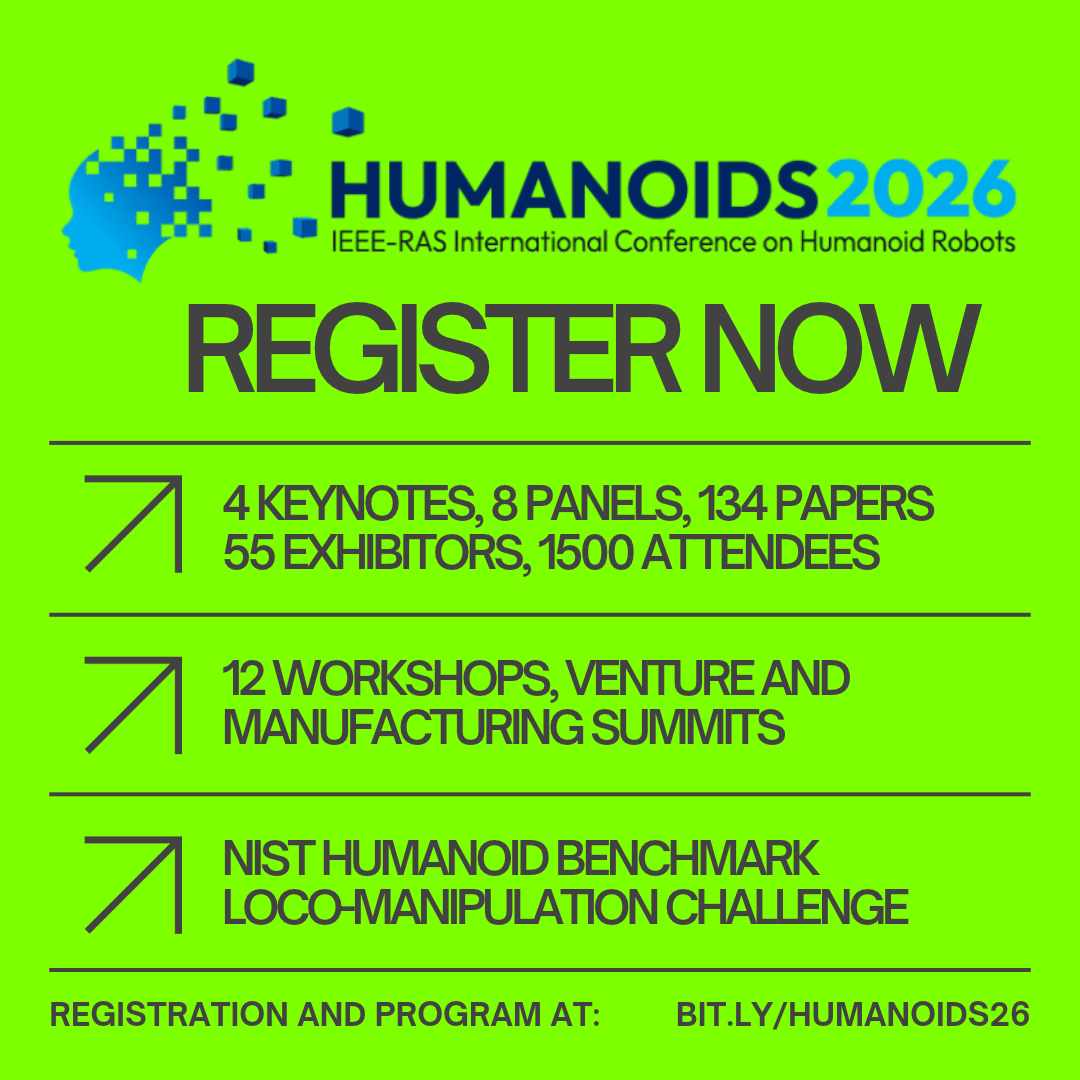
IEEE Humanoids 2026 – SCCC – Dec 6-9 – HUMS26SVR20% – expires Nov22
* including SVR Venture and Manufacturing Summits – Dec 7
Discount code expires Nov 22
Quori Community Beta Program – Early Access to Purchase a Quori Robot!
The Quori team is now accepting applications to join the Quori Community Beta Program and purchase a Quori 2.0 robot at a 60% discount subsidized by our NSF grant!
Learn more by reviewing the full solicitation HERE and apply for a Quori 2.0 robot via the Google Form HERE by Friday, December 18th, 2026.
Quori is an NSF-funded, multi-award-winning, community-informed, not-for-profit, open, modular, social robot platform for the robotics research community (
). You can see the latest version of Quori in the one-minute YouTube video here:
https://www.youtube-nocookie.com/embed/VFLEs2hwCtY?rel=0&autoplay=0&showinfo=0&enablejsapi=0
The Quori Community Beta Program invites proposals from collaborative teams led by a U.S. based research organization (university, non-profit or government research lab) who wish to purchase a Quori 2.0 prototype robot. Participants will learn about, assemble, and receive a Quori 2.0 modular robot platform; in addition, Quori Community Beta Program participants will be eligible to receive a manufactured production-grade Quori 2.0 of comparable configuration (e.g., lower body, upper body, or full body) when they become available.
You are encouraged to forward this to anyone you think might be interested in Quori.
If you have any questions or comments, please contact Quori.Robot@gmail.com and/or join the Quori Community Discord server (https://discord.gg/k5kfPcgRUM).
Thanks again for your interest! We are excited to welcome you to the Quori community!
—
The Quori Project Team
* Ross Mead (Semio)
* Bill Smart (Oregon State University)
* Mark Yim (University of Pennsylvania)
* Simon Kim (University of Pennsylvania)
* Naomi Fitter (Oregon State University)
Looking for skilled tradespeople?
If you are a robotics company looking for skilled tradespeople, the Association of Manufacturers Bay Area’s Workforce Development Board and the Bay Area Community Colleges can help.
Let us know what you’re looking for and we’ll pass it on.
Silicon Valley Robotics Investor/Startup Database
Every month or two we share updated startup information with accredited investors. These investors write checks anywhere from angel and seed stage to $5-50 million.
- Feedback from the startups – high quality inbound interest from investors.
- Feedback from the investors – incredible depth and range of robotics startups.
Are you a startup fundraising atm? Fill out our “For Investors Eyes Only” sheet.
If you’re an accredited investor and haven’t already signed up for the spreadsheet – Sign up here for great robotics deal flow!
If you enjoy Robots & Startups please restack. To receive new posts and support my work, consider becoming a free or paid subscriber.
Coreweave Physical AI Launchables
CoreWeave has launched CoreWeave Physical AI Launchables, which makes simulation and synthetic data generation for physical AI workloads easier to set up and more efficient to run. Workloads ship as tested Templates for NVIDIA Isaac Sim, CARLA, MuJoCo, NVIDIA AlpaSim and NVIDIA Cosmos 3. A team picks one, points it at their own data, and runs it with one command. CoreWeave’s benchmarks show up to 2.7x more usable outputs per GPU-hour, meaning every GPU-hour produces more validated output and the GPUs a team already pays for go further.
https://www.coreweave.com/products/physical-ai-launchables
Apptronik…
Reaching out with some news from Apptronik — following the success of their initial partnership, Apptronik and GXO today announced an expansion of that partnership, with the intent to deploy 1,000 robots over the next four years, starting in 2027. This is one of the largest humanoid robot commercial frameworks in logistics to date. It’s a major validator of Apollo’s capabilities and marks a major step for humanoid robotics moving out of the lab and into commercial deployments.
GXO and Apptronik will expand joint trials of Apollo in live operations across warehouse workflows. Then, in 2027, the trials will validate the safety, security, and technical requirements for scaled deployment. This will be a concrete case of humanoids working alongside humans, doing the repetitive, time-consuming work that takes up valuable time on factory floors while GXO team members focus on more complex tasks.
The full press release is linked here, and imagery is attached to this email. Let me know if you have any questions!
Robotics News
French robot maker Genesis raises $500 million at $3.5 billion valuation – Reuters
Rockwell Automation Signs Definitive Agreement to Acquire AGILOX – Rockwell
Elroy Air Scores a $70m deal for its autonomous heavy-cargo drone in the UAE – Autoevolution
Waymo Has Been Banned From Operating Autonomous Vehicles on California Freeways, DMV Says – Road&Track
U.S. Manufacturing Faces an Automation Transition as Labor Shortages Persist Despite More Factory Robots – The Economy
Nestle Eyes Autonomous Factory Lines and Looks to Google, Microsoft as Partners – WSJ
With exoskeletons, the bionic body will go mainstream – The Economist
Nations agree to extend talks on AI killer robots but no firm commitment to rein them in – APNews
International UN talks on controlling use of autonomous weapons collapse – The Guardian
U.N. Fails to Regulate Lethal Autonomous Weapons, but Plans to Try Again – NYT
How to Reshape the US Military for Autonomous Warfare by David Petraeus and Curtis Buzzard – National Interest
Robotics Events:
Bots, Bevs & Humanoids – SF – Dec 2
IEEE Humanoids 2026 – SCCC – Dec 6-9 – HUMS26SVR20% – expires Nov22
* including SVR Venture and Manufacturing Summits – Dec 7
Want to host an event or reach the robotics community?
Many companies are reaching out to Silicon Valley Robotics about hosting events, outreach or hiring and we have a great community network, of people looking for work, of investors interested in deal flow and of technologists interested in learning about the latest advances.
Would you be interested in hosting the next Bots, Bevs and Devs? Or something customized specifically for your goals? Reach out here!
Or join the organizing team at Silicon Valley Robotics – bots&beer@svrobo.org