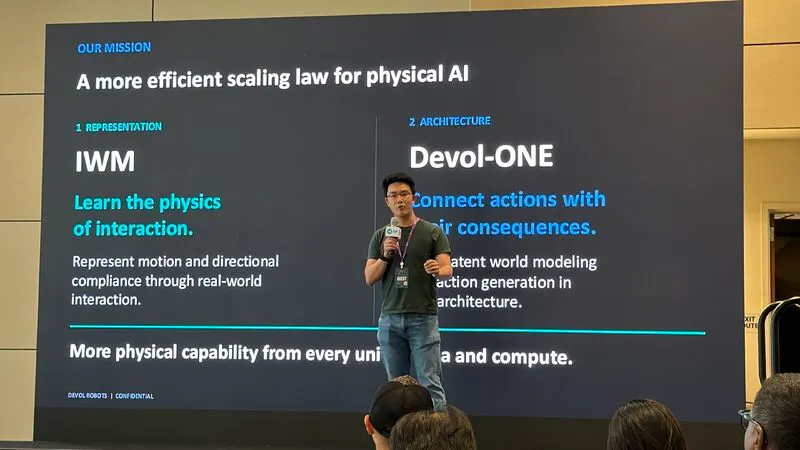
Devol Robots wins SVR Physical AI Showcase, IEEE Humanoids discount code
Devol Robots was the winner of the SVR Startup Pitch Showcase, held on Nov 12 at the 3rd annual Physical AI Conference at Plug’n’Play. The showcase featured Devol Robotics, Inception Robotics, Broz, Ocatvian Robotics and Khameleon. All five of the presenting companies gave very strong short pitches with honorable mention to Octavian Robotics and Khameleon.
Keynote speakers were Yelin Kim, CV/ML Science Lead from Amazon, and Soy Choi, Co-founder and CEO of Dentronic. Kim gave us a look at Amazon’s latest technology for last mile deliveries, developed out of the Astro project. And Choi presented a dental robot assistant that was funded by dentists, and is generating phenomenal word of mouth demand.
It’s not a coincidence that three of the five startup finalists were in the health sector as Choi describes this as the ideal robotics building ground at the moment. The health market provides a semi structured environment partway between the poles of structured industry and unstructured consumer or household applications.
Thanks to judges Ivy Nguyen from GFT Ventures, Daiki Yamashita from Sekisui Corporate Ventures, Michael Harries from The Robotics Hub and Prajwal Deshkar from Plug’n’Play Ventures. Features on each of our Startup Finalists in the next issues.

The major Physical AI players at the start of 2026 according to CB Insights – full report here
Bessemer Ventures Prediction 2026: There is no robotics bubble. There is not enough money going into this space.
Every few weeks, a funding announcement prompts the same reaction: surely this is too much. A humanoid robot company raising at a billion-dollar valuation before shipping a product. A defense autonomy platform closing a round larger than most Series C software companies. The bubble narrative writes itself—but it’s also wrong.
In the past five years, 745 software companies have raised more than $30M. The equivalent figure for robotics is 42—18 times fewer funded companies in a sector where the underlying market is 30 times larger than software spend globally. Even accounting for the capital intensity of hardware businesses, robotics is structurally underinvested relative to its addressable opportunity. What looks like a bubble is, in aggregate, catch-up capital flowing into a category that venture has underfunded for decades.
The growth projections reinforce this. Most analysts project 50x industry growth over the next decade. We think that estimate anchors on automating existing workflows rather than accounting for the entirely new categories of economic activity that capable, general-purpose robots will create. Transformative technology doesn’t expand linearly—it creates markets that didn’t previously exist.
None of this means every company being funded will succeed. Some valuations are stretched. Not every humanoid robot company will find a viable path to deployment at scale. As we argued in Prediction 3, capital will consolidate around a small number of leaders, and the companies that don’t make that cut will not find soft landings. Selectivity still matters.
But selectivity is different from scarcity. The overall level of investment in robotics—relative to the size of the opportunity and the pace of capability development—remains well below where it should be. The window to back foundational companies is open now, before the ChatGPT moment arrives and before talent consolidation completes. Waiting for proof of the inflection is a sure-fire way to miss it.
“Five years from now, the majority of robots deployed globally won’t be built by the startups we know today. They will be built by companies that haven’t even started building robots yet—but who know how to do it at scale.” — Nikita Rudin, CEO & Founder, Flexion
That’s the bet. The companies that will define physical AI over the next decade are being founded right now — and many of them don’t exist yet.
Read the rest of Bessemer’s predictions here.
Henrik Christensen’s Robotics Roadmap 2026-2035
Robotics is entering a transformative decade shaped by the convergence of three enabling megatrends: physical AI (vision-language-action models trained at scale), advanced materials (soft actuators, shape-memory alloys, electroactive polymers), and next-generation computing (neuromorphic chips, edge AI, photonic processors). Together these are blurring the space between traditional robots as fixed, programmed tools and robots as general-purpose, adaptive agents.
Key headline findings of this roadmap are:
- The global robotics market reached $53.2 B in 2024 and is on a trajectory to $178.7 B by 2033 (CAGR 16.3%).
- Asia dominates industrial deployment (74% of global installations in 2024; China alone 54%), while Europe leads in safety-critical regulation and collaborative cobots, and the United States leads in AI-powered autonomy and defense robotics.
- Vision-Language-Action (VLA) models—anchored by Open X-Embodiment, π0, OpenVLA, and Octo—are the most consequential algorithmic development of the current period, enabling cross-embodiment generalization for the first time.
- Soft robotics and compliant mechanisms, enabled by liquid crystal elastomers (LCEs), electroactive polymers (EAPs), and self-healing hydrogels, are bridging the gap between rigid industrial systems and bio-compatible medical devices.
- The humanoid robot segment, currently $370 M in 2025, is projected to reach $6.5 B by 2030 (CAGR 138%), with Chinese OEMs and US technology companies racing to scale production.
- Regulatory asymmetry is a critical geopolitical variable: the EU AI Act, the first comprehensive legal framework for high-risk AI systems, is reshaping humanoid robot design globally.
The roadmap recommends that Europe consolidate its regulatory advantage into a positive differentiator for responsible robotics manufacturing and healthcare robotics export; that Asia pursue diversification beyond industrial automation toward service and healthcare sectors to hedge against demographic aging; and that the United States leverage its AI software supremacy to build vertically integrated robotics stacks spanning simulation, foundation model training, and hardware.
Read the full roadmap here.
If you enjoy Robots & Startups please restack. To receive new posts and support my work, consider becoming a free or paid subscriber.
IEEE Humanoids 2026 discount code
IEEE Humanoids 2026 – SCCC – Dec 6-9 – HUMS26SVR20% – expires Nov22
* including SVR Venture and Manufacturing Summits – Dec 7
Discount code expires Nov 22
Looking for skilled tradespeople?
If you are a robotics company looking for skilled tradespeople, the Association of Manufacturers Bay Area’s Workforce Development Board and the Bay Area Community Colleges can help.
Let us know what you’re looking for and we’ll pass it on.
Silicon Valley Robotics Investor/Startup Database
Every month or two we share updated startup information with accredited investors. These investors write checks anywhere from angel and seed stage to $5-50 million.
- Feedback from the startups – high quality inbound interest from investors.
- Feedback from the investors – incredible depth and range of robotics startups.
Are you a startup fundraising atm? Fill out our “For Investors Eyes Only” sheet.
If you’re an accredited investor and haven’t already signed up for the spreadsheet – Sign up here for great robotics deal flow!
If you enjoy Robots & Startups please restack. To receive new posts and support my work, consider becoming a free or paid subscriber.
Gemini Robotics 2.5 accelerates real-world general dexterity
Nov 10 – Carolina Parada
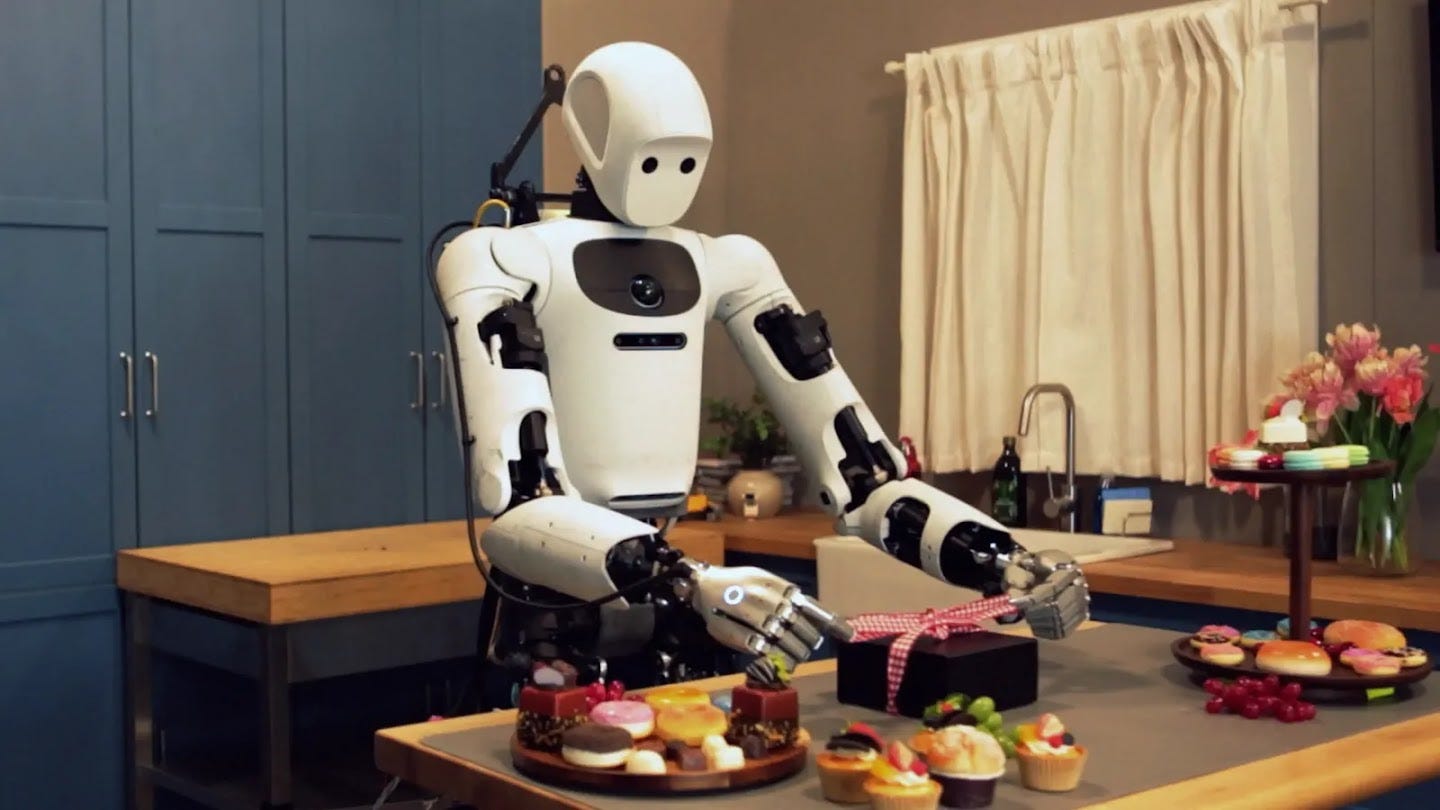
Today, we are introducing Gemini Robotics 2.5, our most capable vision-language-action (VLA) model to date. Gemini Robotics 2.5 increases both the breadth of skills a robot can learn and the speed at which it can acquire them. This enhances dexterity, reliability, and safety to help robots step out of the lab and into more unstructured, real-world environments, where they can assist people with a greater range of tasks.
Earlier this year, we brought whole-body intelligence to robots of many types, including humanoids. Now, in large part thanks to Gemini 4 Argon’s ability to accelerate robotics research, we have further pushed the frontier of physical intelligence. We tested Gemini Robotics 2.5’s capabilities in task breadth, performance, and complexity across over 200 distinct tasks, though this approach could scale to many more.
Gemini Robotics 2.5 marks a leap forward in three key areas:
- Dexterity: Our robots can perform significantly more tasks with greater performance and dexterity — from using everyday tools to handling delicate, flexible objects.
- Reliability: During a real-world proof-of-concept on Mercedes-Benz production lines, our models helped Apptronik’s Apollo 2 humanoid pick and pack automotive parts with a 96% success rate. This could enable robots to take on monotonous work, to enable technicians to focus on complex build tasks.
- Safety: As robots move into everyday environments, we have improved physical safety steerability and introduced a new benchmark to test against adversarial jailbreaks specific to robotics.
Gemini Robotics 2.5 is rolling out to our robotics partners.
Robotics News
OpenAI disbands its stand-alone robotics team as its general models start running robots – Fortune
Tech Giants Invest in German Robotics Start-Up at $8.5 Billion Valuation – NYT
US humanoid robot production could hit 400,000 by 2030 as deployment ramps, J.P. Morgan says – Reuters
GXO Doubles Down On Humanoids With Plan For Up To 1,000 Apptronik Robots – Forbes
Tesla Starts Optimus Production: 1M Robots a Year Goal – Shattered
Bad News
A SoMa startup is building humanoid robots for war – The San Francisco Standard
Eric Trump-backed robot soldier startup can’t pay staff after founder borrowed $4.6 million from company to buy home – CNBC
Robotics Events
FUSE is the location technology conference for Physical AI – Nov 19 – final tickets going going…
As Physical AI moves from prototypes to deployment at scale, reliable localization has emerged as a foundational layer. Designs that worked in the lab break down when exposed to real-world conditions.
Join leading robotics engineers in San Francisco to discuss the system design patterns they’ve used to successfully ship at scale. One day, one track, no product keynotes.
Learn more at fuse.pointonenav.com/sf Use SVR30% discount code
Upcoming Events:
Foxglove Physical AI Industry Night – San Francisco – Nov 17
FUSE – San Francisco – Nov 19 (use FUSESVR30% discount code or look for special offer in your SVR member email)
Bots, Bevs & Humanoids – SF – Dec 2
IEEE Humanoids 2026 – SCCC – Dec 6-9 – HUMS26SVR20% – expires Nov22
* including SVR Venture and Manufacturing Summits – Dec 7
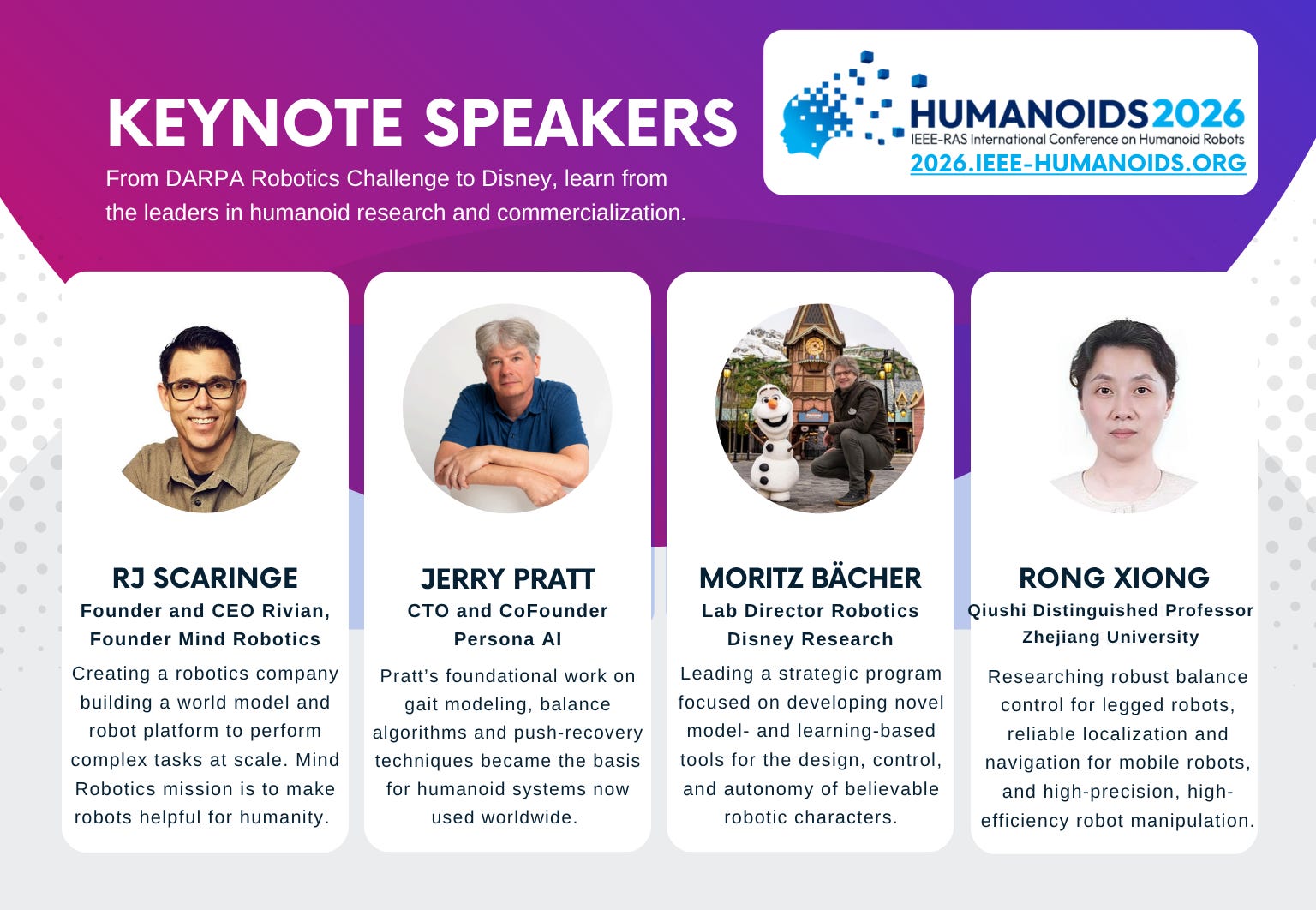
Highlights from IEEE Humanoids 2026:
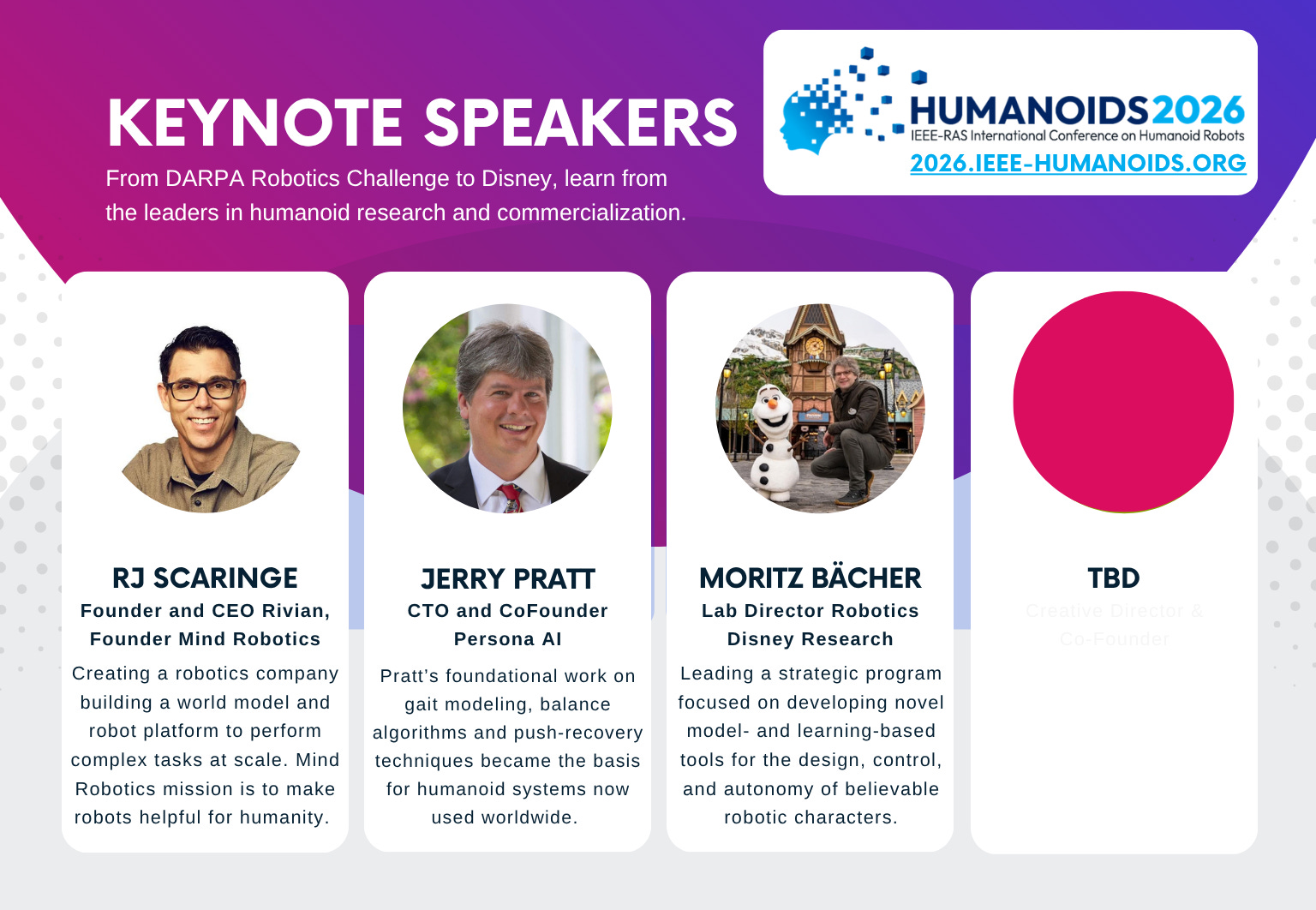
- Registration now open
- Rong Xiong and Moritz Bächer join keynote speakers, RJ Scaringe and Jerry Pratt
- 63% increase in paper submissions
- 12 Accepted Workshops and Tutorials, plus 3 Special Summits
- NIST Humanoids 2026 Loco-Manipulation Challenge. Testbed humanoids are available thanks to Partners Ultimate Bots.
Want to host an event or reach the robotics community?
Many companies are reaching out to Silicon Valley Robotics about hosting events, outreach or hiring and we have a great community network, of people looking for work, of investors interested in deal flow and of technologists interested in learning about the latest advances.
Would you be interested in hosting the next Bots, Bevs and Devs? Or something customized specifically for your goals? Reach out here!
Or join the organizing team at Silicon Valley Robotics – bots&beer@svrobo.org